


When it comes to biological products, not all crops respond the same.
That’s especially true for dicot crops like soybeans, peanuts, and cotton. Their root structures, nutrient demands, and interactions with the soil environment are fundamentally different from monocots. Yet many biological programs are built to serve a wide range of crops without accounting for those differences.
That’s where the opportunity lies.
The Difference Starts in the Root Zone
Dicot crops develop a taproot system with lateral branching that drives how they access water and nutrients. This structure creates a unique interaction between the plant and the surrounding soil biology.
To perform at a high level, dicots rely on:
- Strong early root establishment
- Efficient nutrient uptake through lateral roots
- A balanced and active microbial environment
If the biology in the soil is not aligned with how these crops function, performance can be limited from the start.
“Dicot crops interact with the soil differently than monocots. If your biological program doesn’t account for that, you’re leaving performance on the table,” said Bert Rigan, Director of Agronomy.
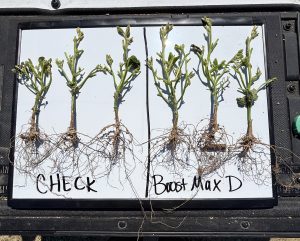
Why a Targeted Approach Matters
Biological products can play an important role across a wide range of crops and systems. But as growers continue to fine-tune their fertility programs, there’s an increasing focus on matching solutions more closely to specific crop needs.
Dicot crops bring a different set of demands in the root zone, which creates an opportunity to take a more targeted approach.
“Different crops interact with the soil in different ways. When you can better align your biological program with that, you can drive more consistent performance,” said Bert Rigan, Director of Agronomy.
A targeted system doesn’t replace a broader biological strategy. It builds on it by:
- Supporting crop-specific root development patterns
- Enhancing nutrient uptake pathways unique to dicots
- Strengthening the soil-to-plant interaction where it matters most
A Targeted Approach for Dicot Crops
To truly support dicot performance, a biological system needs to do more than introduce microbes. It needs to enhance the relationship between the soil and the plant.
That means:
- Providing a consistent food source to sustain microbial activity
- Supporting early root development to maximize uptake potential
- Improving the efficiency of nutrient movement from soil to plant
By combining a tailored biological consortium with a proprietary food source, Boost Max™ D leverages BioTek® technology to strengthen the interaction between soil and plant specifically in dicot cropping systems.
When paired with Biovate XP®, the system is further enhanced with RootTek® technology, bringing BioTek® and RootTek® together to drive a stronger soil-to-plant connection.
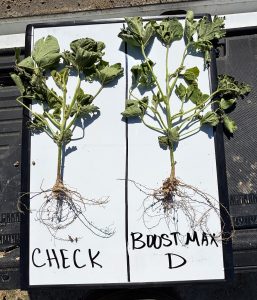
What This Looks Like in the Field
When this interaction is optimized, growers can see measurable differences in both plant development and yield.
In 2025 soybean trials:
- Indiana: +1.4 bu/ac increase (+$8.76/ac)
- Indiana: +5.8 bu/ac increase (+$56.00/ac)
- Ohio: +4.5 bu/ac increase (+$40.26/ac)
- Missouri: +1.1 bu/ac increase (+$5.61/ac)
- Arkansas: +5.8 bu/ac increase (+$54.96/ac)
These results were observed primarily with in-furrow applications at planting, reinforcing the importance of early root zone activation.
“Getting biology in the right place at the right time is critical. When you start strong in the root zone, everything else builds from there,” Rigan said.
Building a Better Soil-to-Plant Connection
At the end of the day, performance in dicot crops comes down to how well the plant and soil are working together.
A targeted biological approach:
- Supports stronger, more efficient root systems
- Enhances nutrient availability and uptake
- Helps crops better manage stress throughout the season
And most importantly, it does so in a way that aligns with how dicot crops actually grow.
Because when the biology matches the crop, performance follows.
Want to see how Boost Max™ D fits into your program?
Connect with our team to learn more about application strategies, placement, and how to get the most out of your biological program.